
By Gaby Dufresne-Cyr, CBT-FLE
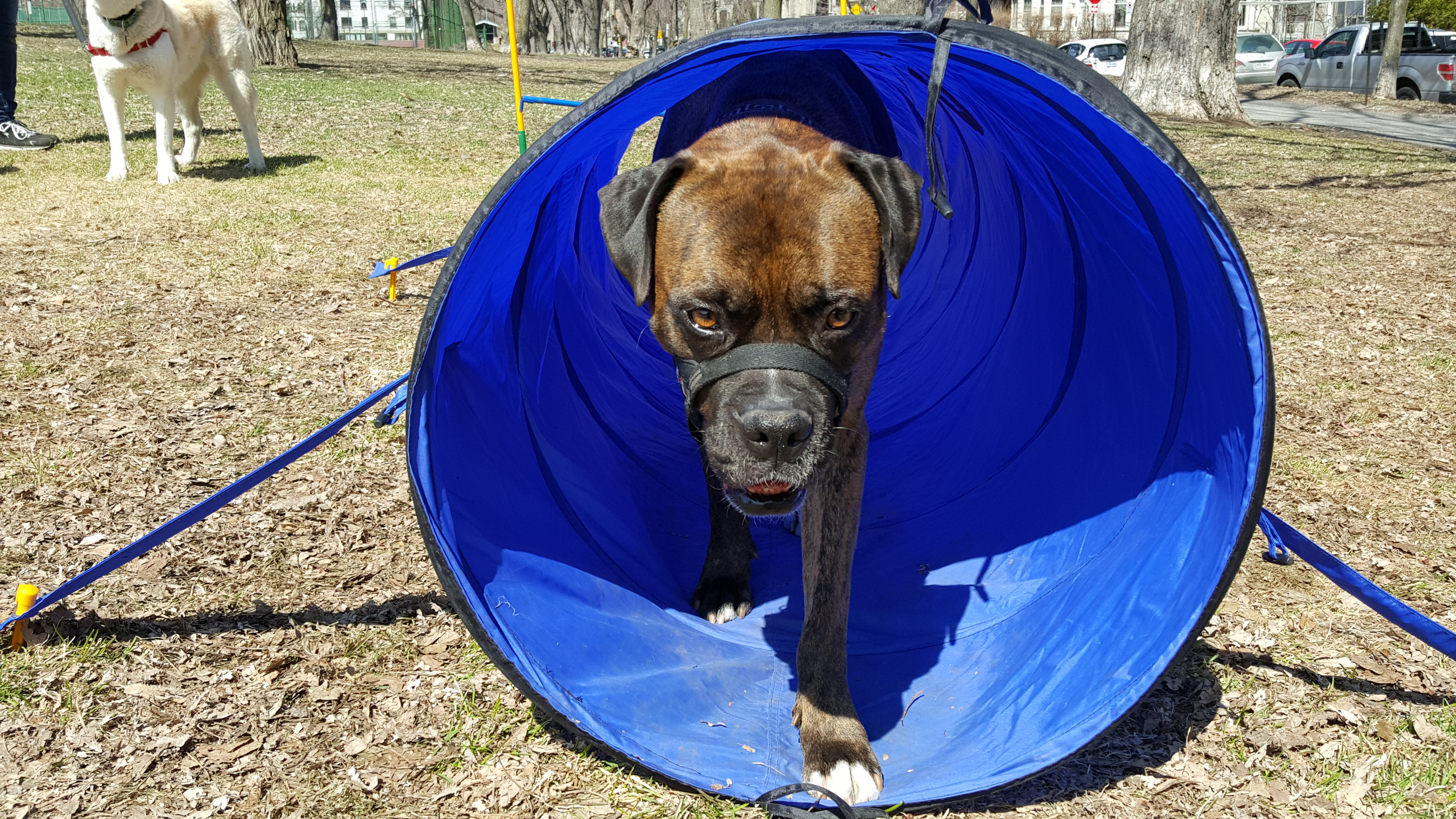
In many traditional training contexts, obedience has long been the benchmark of a well-trained dog. The sit, down, stay, and heel behaviours are essential skills, and they certainly make life with dogs safer and more manageable. Yet, focusing solely on compliance overlooks an important dimension of canine learning: the ability to make independent decisions. By fostering problem-solving and decision-making, trainers not only expand a dog’s cognitive capacity but also enhance resilience, adaptability, and emotional regulation.
The Psychology of Behaviour
From a psychological perspective, the skills we want to nurture fall under the umbrella of executive function: a set of processes that includes working memory, inhibitory control, and cognitive flexibility (Diamond, 2013). For dogs, this means the capacity to hold information in mind, inhibit an immediate impulse (e.g., not lunging at a squirrel), and shift strategies when one approach fails. These abilities are central to what psychologists call self-regulation, the process by which an individual manages behaviour, emotions, and attention in pursuit of long-term goals.
In training practice, cultivating these capacities involves creating opportunities for dogs to practise inhibitory control and self-directed problem-solving. Rather than always telling the dog what to do, trainers can design exercises that invite choice-making. For instance, instead of cueing a dog to sit every time another dog passes, one might reinforce voluntary check-ins. This shifts the emphasis from compliance (sit because I said so) to self-regulation (I choose to disengage and orient back to my human).
Problem-solving and Decision-making
Problem-solving games are another effective way to engage canine executive functions. Puzzle feeders, scent discrimination tasks, and shaping exercises allow dogs to experiment, test hypotheses, and adjust strategies when faced with novel challenges. Shaping, in particular, is a powerful tool: by reinforcing successive approximations, trainers encourage dogs to think creatively and explore behavioural options without relying on constant guidance. In doing so, the trainer becomes less of a micromanager and more of a facilitator of learning.
Importantly, fostering decision-making does not mean abandoning structure or boundaries. In fact, it requires careful scaffolding (Vygotsky, 1978). Just as educators gradually build children’s capacity for independence, trainers must design environments that support success while allowing space for mistakes. Short sessions with clear reinforcement contingencies, gradually increasing difficulty, and consistent feedback help dogs develop confidence in their own agency.
Ultimately, training that goes beyond obedience aligns with contemporary understandings of canine cognition and welfare. By promoting decision-making, we respect dogs as thinking, feeling beings capable of more than mechanical compliance. This translates into dogs who are not only responsive to cues but also capable of making sound choices in unpredictable environments; whether that means waiting calmly at a doorway, navigating a novel agility course, or resolving a social encounter with grace, dogs can problem-solve and make effective decisions.
Training, then, is not just about control. It is about cultivating the cognitive and emotional skills that allow dogs to thrive in a human world. We can reach our dog training goal faster by using other learning theories such as social cognitivism, constructivism, and situativism.
Reference
-
Diamond, A. (2013). Executive functions. Annual Review of Psychology, 64, 135–168. https://doi.org/10.1146/annurev-psych-113011-143750
-
Vygotsky, L. S. (1978). Mind in society: The development of higher psychological processes. Harvard University Press.