
By Gaby Dufresne-Cyr, CBT-FLE
The plasticity of the dog's brain and their ability to learn using the social cognitive learning theory are two topics most professional dog trainers are unaware of. The canine cortext is an extraordinary example of neuroplasticity, the capacity of the brain to reorganize itself by forming new neural connections throughout life.
For dog trainers who apply social cognitive learning theory, a framework suggesting that animals, including humans, learn by observing and mimicking others, understanding neuroplasticity is essential. By tapping into the brain’s malleability, professional dog trainers can optimize training methods, allowing for more adaptive and meaningful learning experiences for dogs.
The Plasticity of the Dog’s Brain
Neuroplasticity is the brain’s ability to adapt and change in response to new experiences, environment, or injuries. Research has shown that both human and non-human animals experience significant neural development in environments rich in physical, social, and mental stimulation. For example, studies involving functional MRI scans reveal that dogs' brains show increased activity in regions linked to cognitive processing when exposed to interactive learning, such as directive Brain Games, or challenging environments (Andics et al., 2016).
This supports the idea that dogs can rewire parts of their brain to improve or develop certain skills, much like humans do. In particular, dogs possess specific brain regions, like the prefrontal cortex, which are involved in decision-making and memory. These regions are highly receptive to training and social experiences, showing that dogs are well-equipped to learn from social interactions and can retain these learning experiences over time (Hecht et al., 2020).
Social Cognitive Learning Theory and Its Relevance in Dog Training
Social cognitive learning theory, initially proposed by Canadian psychologist Albert Bandura, posits that learning can occur through observation, imitation, and modeling without direct reinforcement. Applied to dogs, this theory suggests that dogs can learn new behaviours by watching humans or other dogs. A classic example is the imitation technique, where dogs are taught to imitate specific behaviours demonstrated by a trainer or another dog. Research shows that dogs are capable of mimicry and that training methods emphasizing social and cognitive learning are both engaging and effective, given the dog’s natural predisposition to observe and mimic (Fugazza & Miklósi, 2014).
This technique relies heavily on a dog’s neuroplasticity. As dogs are exposed to repeated social learning sessions, their neural pathways strengthen, particularly in regions responsible for motor skills and memory. Over time, these adaptations make the learned behaviours more automatic and integrated into the dog’s repertoire, even in new contexts.
Practical Implications for Trainers
Enhancing Learning Speed and Retention: By leveraging neuroplasticity, trainers using social cognitive learning can expedite the learning process. When dogs are exposed to consistent social cues and positive reinforcement, their brains create stronger associations between actions and outcomes. This facilitates faster acquisition of complex behaviours and improves retention.
Improving Problem-Solving and Adaptability: Neuroplasticity allows dogs to adapt their responses to different scenarios, making them more resilient problem-solvers and decision-makers. Professional dog trainers can introduce problem-solving exercises that encourage dogs to observe and mimic strategies demonstrated by others, thereby fostering adaptability.
Building Emotional Intelligence: Dogs with enriched social environments often show improved emotional regulation and empathy towards other dogs and humans (Pongrácz et al., 2020). By using social cognitive learning methods, trainers help dogs develop skills in interpreting social cues, which can be valuable in settings where dogs interact frequently with humans or other animals.
Neuroplasticity, Social Learning, and Positive Reinforcement
It’s important to note that neuroplasticity is heavily influenced by the type of reinforcement used. Positive reinforcement, a core principle in social cognitive learning, encourages dogs to associate training with rewards rather than fear. Studies show that positive reinforcement stimulates the release of dopamine, a neurotransmitter that enhances motivation and strengthens memory formation, thus supporting brain plasticity (Cook et al., 2016). In contrast, punishment-based methods can increase stress levels and reduce the brain's capacity to form beneficial associations, undermining the dog’s ability to learn through social observation.
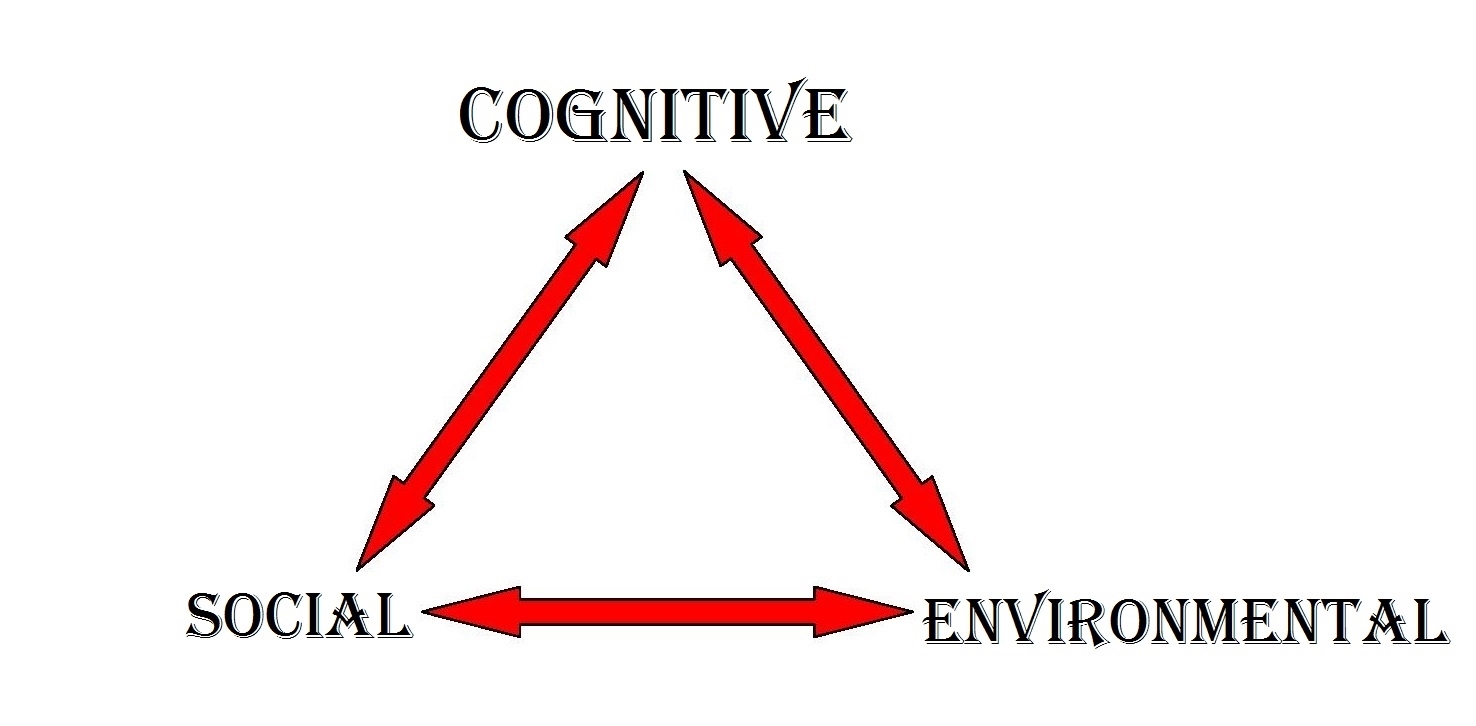
Bandura (1977; 1978), discussed the social cognitive learning theory as a reciprocal determinant model. The three determinants are social, cognitive, and environmental. Cognitive learning further contributes to neurodevelopment by allowing the learner to apply past knowledge to new situations and environments.
Building a Brighter Training Future with Social Cognitive Learning
Understanding and applying neuroplasticity is transforming professional dog training practices, especially in methods aligned with social cognitive learning theory. By fostering environments that promote observation, imitation, cognitive development, and positive reinforcement, trainers can maximize the dog’s natural learning capacities, leading to well-rounded and adaptable canine companions. This approach respects the intelligence and emotional needs of dogs, ultimately enhancing trust between humans and their pets and showcasing the remarkable adaptability of the canine brain.
References:
- Andics, A., Gácsi, M., Faragó, T., Kis, A., & Miklósi, A. (2014). Voice-sensitive regions in the dog and human brain are revealed by comparative fMRI. Current biology : CB, 24(5), 574–578. https://doi.org/10.1016/j.cub.2014.01.058
- Fugazza, Claudia & Miklosi, Adam. (2015). Social learning in dog training: The effectiveness of the Do as I do method compared to shaping/clicker training. Applied Animal Behaviour Science, 171, 146-151. https://dog.org/10.1016/j.applanim.2015.08.033
- Bandura, A. (1978). The self system in reciprocal determinism. American Psychologist, 33(4), 344–358. https://doi.org/10.1037/0003-066X.33.4.344
- Bandura, A. (1977). Social learning theory. Prentice Hall.
- Bernhardt, Boris & Singer, Tania. (2012). The Neural Basis of Empathy. Annual review of neuroscience, 35, 1-23. https://doi.org10.1146/annurev-neuro-062111-150536
- Bräuer, J., Eichentopf, D., Gebele, N., Jandke, L., Mann, V., Schulte, K., & Bender, Y. (2024). Dogs distinguish authentic human emotions without being empathic. Animal cognition, 27(1), 60. https://doi.org/10.1007/s10071-024-01899-x
- Kujala, M. V., Parkkonen, L., & Kujala, J. (2024). Empathy enhances decoding accuracy of human neurophysiological responses to emotional facial expressions of humans and dogs. Social cognitive and affective neuroscience, 19(1). https://doi.org/10.1093/scan/nsae082
- Miklósi, Á., Topál, J., & Csányi, V. (2004). Comparative social cognition: what can dogs teach us? Animal Behaviour, 67(6), 995-1004. ISSN 0003-3472. https://doi.org/10.1016/j.anbehav.2003.10.008
- Spunt, R.P., Ellsworth, E., & Adolphs, R. (2017). The neural basis of understanding the expression of the emotions in man and animals. Social Cognitive and Affective Neuroscience, 12(1), 95–105. https://doi.org/10.1093/scan/nsw161