
By Gaby Dufresne-Cyr, CBT-FLE
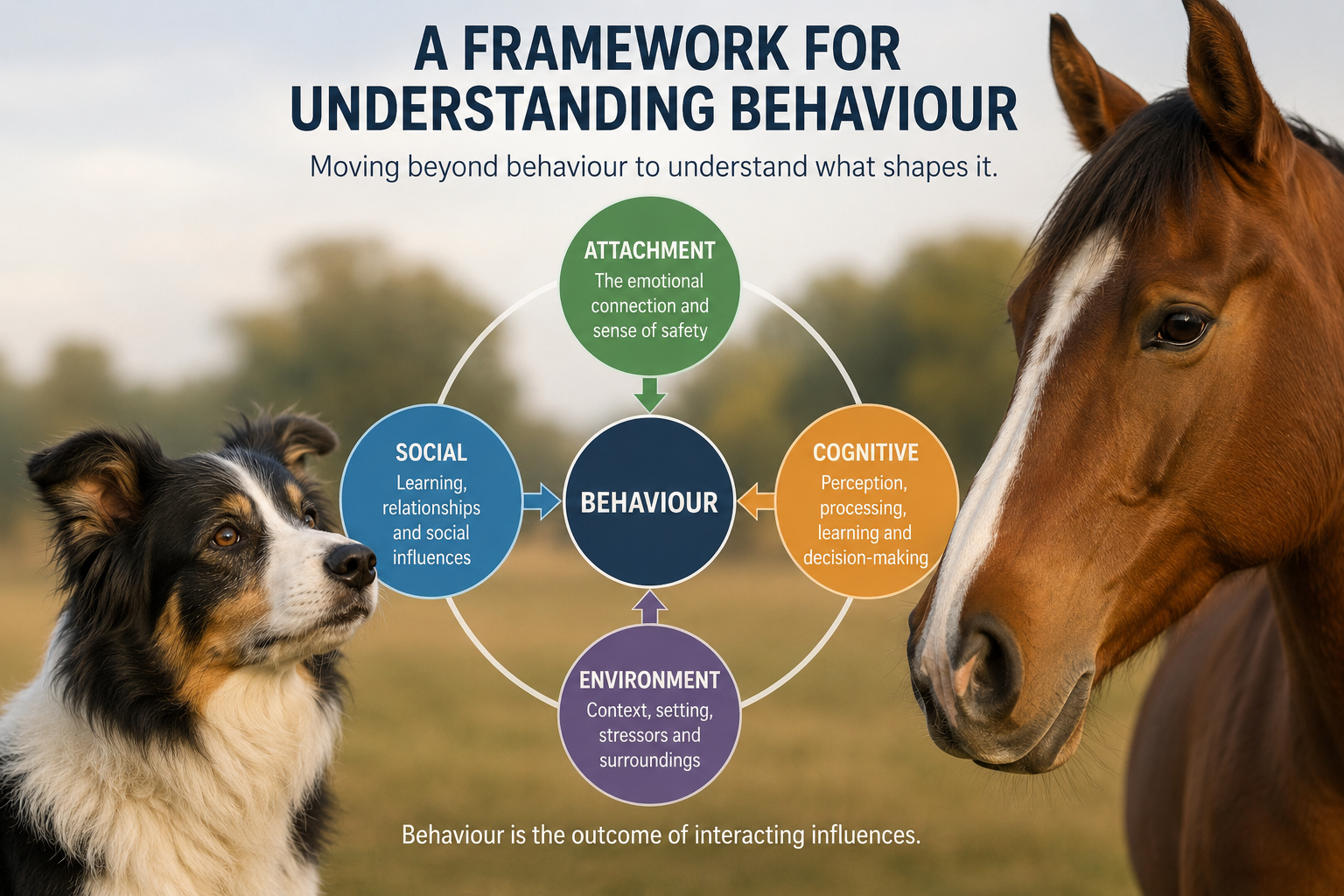
Animal training has never lacked information; it has theories, methods, techniques, and generations of practical application. What it has lacked is something more fundamental: a way to see how all of these pieces actually fit together into a coherent animal training framework.
Most disagreements in animal training come from different people focusing on different parts of the same system. One trainer may focus on reinforcement, another on speed, and another on behavioural fluency. Each perspective captures something real. The problem is that these perspectives are often treated as complete explanations on their own, rather than parts of a larger system. Behaviour is rarely that simple.
The Problem Beneath the Debate
In practice, animal training often becomes fragmented.
Behaviourism explains learning through associations between actions and consequences. Classical and operant conditioning have provided essential tools for shaping behaviour, building skills, and understanding repetition.
However, traditional behaviourism has often overlooked emotional processes and attachment. Attachment theory in animal behaviour highlights the importance of emotional regulation, relational security, and bonding between animal and caregiver which are factors that directly influence learning and response patterns.
Social cognitive approaches focus on social referencing, imitation, perception, problem-solving, memory, and decision-making. These processes help explain why animals respond differently to the same environment or stimulus.
Environmental approaches remind us that context is always active: space, stimuli, stressors, predictability, and physical conditions all shape behaviour in powerful ways.
Each of these perspectives is useful. The difficulty is that they’re often treated as separate systems rather than interacting forces. Yet in real-world dog training and horse training, they are never separate.
Behaviour Is Not the Starting Point
One of the most limiting assumptions in animal training is the idea that behaviour is the primary thing we are working with. In reality, behaviour is the outcome of multiple interacting influences.
A dog that doesn’t recall, a horse that resists pressure, or an animal that appears reactive isn’t expressing a single cause; it’s expressing a combination of influences that may include:
Social context and learning history
Cognitive interpretation of the situation
Attachment-related safety or insecurity
Environmental pressure or overload
Emotional dysregulation and stress response
The outward behaviour is only the final expression of a much deeper process. When we treat behaviour as the cause, we often end up addressing symptoms rather than systems.
Introducing the SCAT Framework
The Social Cognitive Animal Training (SCAT) Framework was developed to address this fragmentation in animal training and behaviour science.
SCAT stands for:
Social influences
Cognitive processes
Attachment dynamics
Environmental conditions
These four elements aren’t separate categories of training. They’re interacting determinants of behaviour that sit beneath what we observe. This shift may seem simple, but it changes how we interpret everything in animal behaviour analysis and training practice.
Instead of asking What is the dog doing? we begin to ask:
What is influencing the social context?
What is the animal perceiving and processing cognitively?
What is the attachment relationship communicating?
What environmental pressures are present?
The behaviour becomes a clue, not a conclusion.
Why the Same Behaviour Can Have Different Causes
One of the most practical implications of a dog training framework like SCAT is that identical behaviours can emerge from entirely different causes.
A dog that avoids recall may be:
Distracted by environmental stimuli
Unclear about the cue or expectation
Experiencing uncertainty in the handler relationship
Overwhelmed by environmental complexity or arousal
Experiencing sensory overload or deprivation
The behaviour looks the same, but the underlying causes are different. Without a framework, training risks becoming repetitive: applying the same solution to different problems and expecting different results. With a structured animal behaviour framework, we begin to diagnose more accurately.
From Training Techniques to Understanding Behaviour
Much of modern dog and horse training focuses on technique:
What to reinforce
When to reward
How to correct
How to manage behaviour
Technique matters, but without structure it can become mechanical. Methods may produce short-term compliance without long-term understanding.
The SCAT Framework shifts the focus from technique to interpretation, clarifying when and why methods should be used. SCAT asks a different question: What is actually influencing this behaviour?
Why This Matters in Dog and Horse Training
Animals don’t experience their world in isolated categories; they experience it as an integrated system. When training ignores that system, we risk misreading or misunderstanding behaviour. When training includes an intergrated system, we begin to see behaviour differently:
Defiance becomes communication within a context
Failure becomes information
Resistance becomes an interaction of multiple influences
This doesn’t make training simpler; it makes it more accurate, and accuracy matters more than simplicity in both dog training and equine behaviour work.
Closing Thought
The SCAT Framework didn’t emerge from a single idea. It developed over years of observing a consistent pattern in animal training and behaviour: behaviour becomes clearer when we begin treating it as the outcome of interacting systems.
The framework brings together social learning, cognition, attachment theory, and environmental science into a single structure that reflects how animals actually experience the world.
The scaffolding holding it together isn’t new, but bringing it into a unified animal training framework may change how behaviour is understood and applied in practice.
The goal isn’t to replace existing learning theories or training methods, but to organise them in a way that makes them more usable.
Once we see the system, behaviour starts to make sense.