
By Gaby Dufresne-Cyr
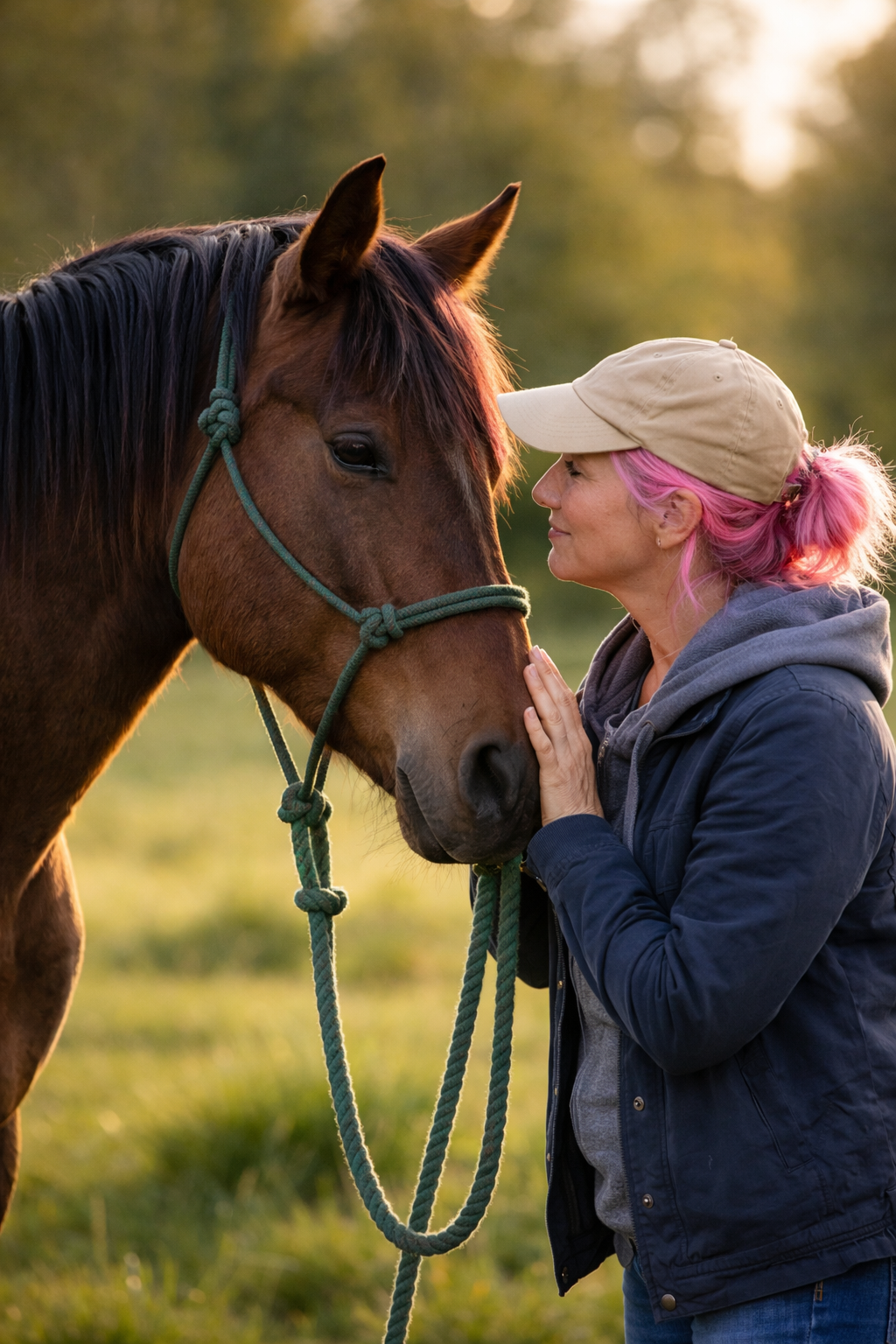
I was halfway through lunch when they came to me. There was a kind of tension in the way they stood there, with urgency and a look that screamed desperation. Peter was back in the field with the mares, bothering them again by trying to mount, stirring things up. No one could get near him long enough to do anything about it. Every attempt turned into a mess. They needed him out quickly and safely.
I remember putting my food down more out of instinct than decision. I had no proper plan, no tools beyond what I always had: my clicker, treats, and a lead rope. When my colleague asked what the plan was, I replied, I’ll just walk out to the field and get him.
From the outside, it probably didn’t look like much. A woman crossing a pasture and a horse standing in the distance, but anyone who had tried to halter him before knew it wasn’t simple.
Peter didn’t let people walk up to him. He didn’t quietly accept a halter or cooperate.
Not with them, yet three minutes later, I was walking him out. Halter on and holding his head low. There was no rush or resistance, just a horse beside me, leaving the field as if this had always been easy.
The Truth Behind the Moment
What people saw in that moment didn’t match the story they had been living with.
This was the same horse that had charged at people. The same one who had bitten hard enough that no one forgot it. He had thrown three riders and broken a girl’s arm. By the time I arrived months earlier, the word dangerous had settled around him like something fixed, something permanent. To be fair, if you only looked at the behaviour, it fit, but behaviour has a history; it always does.
Peter hadn’t grown up around people. He was wild-caught at around two and a half years old, pulled out of the Albertan prairies with the rest of a group that had never needed humans to survive. He spent the next year in a large pen with other horses like him, unhandled, learning very little except how to stay alert, how to react, and how to hold his ground when he needed to.
People roped him twice, once in nature and again in the large paddock. After that, things escalated quickly in the way they often do. Pressure and release, followed by more pressure and punishment. Eventually, they put a saddle on him, enough to get someone on his back and ride him. Nothing made sense to him. Then, the organization sold him, and he moved across the country to the east. From there, the people turned him out into a paddock and mostly left him alone again. Another year passed like that.
So, by the time I met him in the spring of 2025, there was nothing surprising about who he had become. Peter bit because it worked, and charged because it created space. He resisted because nothing in his experience suggested he shouldn’t. There was no mystery in his behaviour.
The Call to Rise
The owner of the farm didn’t ask me to fix everything, just to do groundwork, and mostly, they wanted him to tolerate being touched. That alone told me how far things had slipped.
I saw him twice a week for a couple of hours each time. There was no rush to it, nor a sense that we had to prove anything by the end of a session. The only decision I made was that I didn’t go in trying to control him. At that moment, I thought of my favourite quote from Virginia Satir: “What we actually need when we come into a new situation is time—all the time that is necessary in any situation to become fully acquainted.” (1988). Everything else followed from there.
I let Peter watch me, move away, break eye contact, and come closer when he was ready. I stayed consistent in a way that didn’t ask from him something that he couldn’t understand yet. There were no sudden reaches, hidden pressure, or moments where the rules changed without warning.
In the Beginning
At first, that kind of work looks like nothing is happening. You stand, wait, and live in the same space as a horse that doesn’t trust you. In that moment, something happens; it starts to notice that you don’t follow the same patterns he’s learned to defend against, that you don’t escalate when he moves away, and that you don’t trap him when he hesitates. Slowly, almost quietly, curiosity replaces tension.
The first time I touched Peter without resistance wasn’t dramatic. I placed my finger on his nose and removed it. I approached a second time, but allowed Peter to choose to make contact. There was no big shift, no obvious moment where everything changed. Peter just stood there, wondering and questioning what I was doing.
Moments like that don’t look like progress from the outside, and they don’t impress anyone watching, but they are the origin of trust and secure attachment.
Three Minutes Prior
By then, putting a halter on Peter wasn’t a fight anymore. I could touch him, move around him, exist beside him without triggering the reactions that had defined him before. He trusted me because I had applied what social cognitive learning tells us; I had been consistent in a way this little brown horse could understand.
So, when I walked into the field that day, I wasn’t thinking about catching him; I was thinking about meeting him where he was, physically and emotionally. Peter saw me almost immediately. He lifted his head, paused, watching. There’s always a moment there, with horses like him, where you can feel the old patterns sitting just under the surface: leave, push, react.
I closed the distance between us slowly and purposefully, letting him decide. It didn’t take long to see his reaction. He looked at me, and I looked away, avoiding any form of social pressure. There was no tension in my approach, thus no need for tightness in his body. He knew nothing would go wrong because our relationship was based on choice and trust. I did what came naturally to me, and I asked Peter for a touch. He approached, I gave him a treat, and that was it; we understood one another.
Peter had no reason to prepare for something to go wrong. He knew I would allow him to make his own decisions, and that I would respect them. The halter went on the same way it had in every quiet session before that, and then we walked out. It took three minutes and two tries to put the halter on him, not because he refused, but because he lifted his head higher than I could reach. On the second try, Peter remembered to lower his head.
Social Cognitive Animal Training Changes Everything
Social cognitive animal training looks easy. That’s the part that stays with people, but ease can be misleading. What looks easy in the moment is often the result of something that took time, patience, and a willingness to do less when doing more would have been faster.
There’s a belief that if you can make a horse do something, you’ve solved the problem. In some ways, you have, but at what cost? Pressure works, so too does control and coercion. You can get a result with negative reinforcement and positive punishment, and sometimes quickly, but those results don’t always hold. When things fall apart; people have to increase the pressure or punishment. That’s when people and horses get hurt.
Nothing about Peter felt unpredictable to me that day because he finally had a way to understand what was happening around him. Peter had been adapting to his environment the only way he knew how: kicking and screaming. That system never gave him options, but once that changed, so did he.
Social Cognitive Horse Training Revolution
People witnessed a horse being easy that afternoon. What they didn’t see was the absence of conflict that made it possible. They didn’t observe the hours of doing very little, the waiting, and the consistency, but that’s where everything changed. Unity is the magic behind social cognitive horse training.
Social cognitive animal training gives you quick wins if you are patient. If you let the horse think and regulate itself, it doesn’t need to be forced because it understands enough to choose. When the freedom of choice is in place, behaviours that once required pressure feel effortless.
If a horse only works when you make him, what you have isn’t trust; it’s control, and control, no matter how well applied, creates avoidance.