
By Gaby Dufresne-Cyr, CBT-FLE
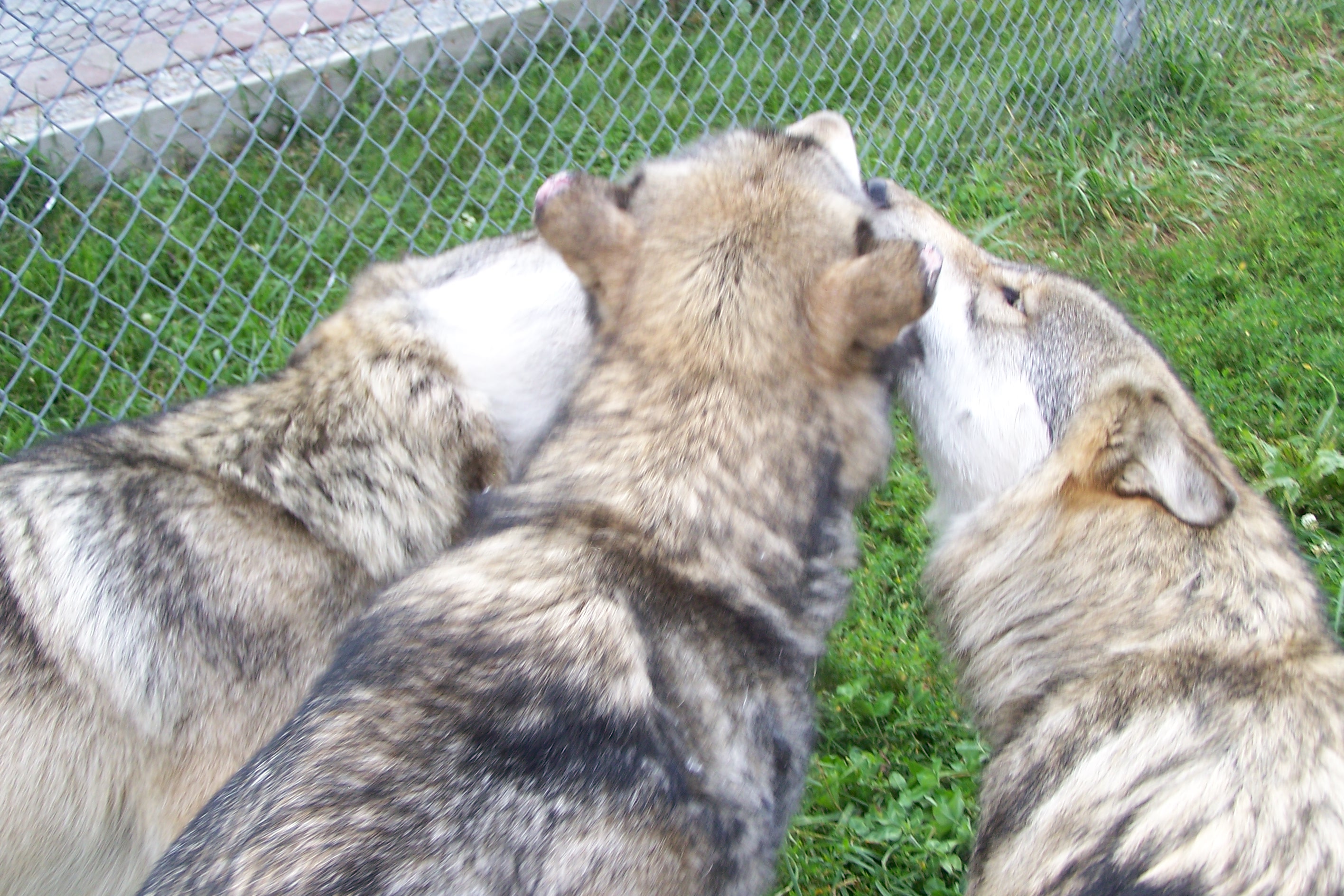
Dogs and wolves are intelligent species that evolved to navigate complex environments through learning, memory, and adaptability. While they share many cognitive traits, domestication has shaped dogs in unique ways. By examining how canines acquire, process, retain, and apply information, we begin to understand how cognition operates across two closely related species.
Acquiring and Processing Information
From an early age, dogs show a strong sensitivity to human communication. Puppies as young as eight weeks reliably follow human pointing gestures to locate hidden food. This ability appears early and is highly heritable, suggesting it was favoured during domestication (Bray et al., 2021). Wolves can also follow human gestures, but only when extensively socialized and raised by humans. Without this experience, wolves typically do not engage with human communicative signals in the same way (Heberlein et al., 2016).
Dogs are keen observers of human behaviour. Their tendency to social reference to human faces and gestures helps them decode intentions. Wolves, on the other hand, show more interest in observing other wolves, particularly in problem-solving contexts. When confronted with a task involving a food reward hidden inside a box, wolves who observed a conspecific solving the task were significantly more likely to copy the solution compared to dogs in the same scenario (Range & Virányi, 2014).
Dogs appear to be more dependent on humans for information, especially when confronted with a challenging or unsolvable task. They tend to look back at people, seemingly asking for help. Wolves, in contrast, persist longer and explore alternative strategies on their own (Range & Virányi, 2013). This difference is often interpreted as the result of domestication selecting for animals that defer to humans rather than solve problems independently (Bohannon, 2013).
Remembering and Naming
In terms of memory, dogs display remarkable retention abilities, especially for object names. Rico, a border collie, was able to learn over 200 object names and retrieve the correct item even after a four-week delay. More impressively, he could learn a new word by exclusion, known as fast mapping or object discrimination, which was previously considered unique to humans (Kaminski et al., 2004; Bloom, 2004).
Another dog, Chaser, learned over 1000 object names and could categorize them functionally. These examples show that some dogs possess a form of declarative memory that enables them to encode and recall specific pieces of knowledge, such as names or instructions, and apply them in novel ways (Kaminski et al., 2004).
Metacognition and Problem-Solving
Dogs also demonstrate metacognitive skills. When uncertain about a hidden object’s location, they are more likely to seek additional information before making a choice. This behaviour suggests they monitor their own knowledge states and adjust accordingly, which is a core feature of metacognition (Belger & Bräuer, 2018).
In scent-based search tasks, dogs are capable of discriminating between odours and appear to mentally represent different objects based on their smell. For example, dogs will search longer and more thoroughly when they realise the object they retrieved was not the one they were cued to find, showing cognitive flexibility and memory of the task (Belger & Bräuer, 2018).
Application in New Situations
Dogs are highly adaptable and able to generalize previously learned behaviours to new situations. A dog taught to retrieve a ball from a basket indoors can apply the same behaviour outdoors or in a different context without retraining. This ability is rooted in their capacity to form mental representations of tasks and adapt them when variables change. Adaptable behaviour is the root of intelligence.
Wolves, while equally capable of learning, apply their skills in different ways. They excel at physical problem-solving, using trial and error and observation of other wolves to complete tasks. They are more persistent and less likely to rely on human intervention. Their imitation learning style is often more rigid but more suited to their ecological role as hunters rather than human companions (Range & Virányi, 2014).
Dogs and wolves both possess strong cognitive abilities. Wolves tend to perform better in physical and independent problem-solving tasks. Dogs shine in human-directed communication, memory of labels, and the ability to generalize behaviours across contexts. These differences reflect divergent evolutionary paths rather than levels of intelligence. Dogs were selected to work with humans. Wolves had to rely on their own kind and their own minds to survive.
Understanding how canines think, learn, and solve problems not only helps us train and care for them more effectively, but also offers insights into how evolution shapes the mind.
References
-
Belger, J., & Bräuer, J. (2018). A ball is not a Kong: Odor representation and search behavior in domestic dogs. Journal of Comparative Psychology, 132(2), 189–199. https://doi.org/10.1037/com0000115
- Bloom, P. (2004). Can a Dog Learn a Word? Science, 304, 1605-606. tttps://doi.org/10.1126/science.1099899
- Bohannon, J. (2013). Who's (socially) smarter: The dog or the wolf? New study challenges assumptions about domestication. Science. https://doi.org/10.1126/article.24420 Retrieved from https://www.science.org/content/article/whos-socially-smarter-dog-or-wolf
- Bray, E.E., Gnanadesikan, G.E., Horschler, D.J., Levy, K.M., Kennedy, B.S., Famula, T.R., & MacLean, E.L. (2021). Early-emerging and highly heritable sensitivity to human communication in dogs. Current Biology, 31(14), 3132-3136. ISSN 0960-9822. https://doi.org/10.1016/j.cub.2021.04.055.
- Heberlein, M.T.E., Turner, D.C., Range, F., & Virányi, Z. (2016). A comparison between wolves, Canis lupus, and dogs, Canis familiaris, in showing behaviour towards humans. Animal Behaviour, 122, 59-66. ISSN 0003-3472. https://doi.org/10.1016/j.anbehav.2016.09.023.
- Kaminski, J., Call, J., & Fischer, J. (2004). Word learning in a domestic dog: evidence for “fast mapping.” Science, 304(5677), 1682–1683. https://doi.org/10.1126/science.1097859
- Range, F., & Virányi, Z. (2013). Social learning from humans or conspecifics: differences and similarities between wolves and dogs. Frontiers in psychology, 4, 868. https://doi.org/10.3389/fpsyg.2013.00868
- Range, F., & Virányi, Z. (2014). Wolves are better imitators of conspecifics than dogs. PloS one, 9(1), e86559. https://doi.org/10.1371/journal.pone.0086559
- Salomons, H., Smith, K.C.M., Callahan-Beckel, M., Callahan, M., Levy, K., Kennedy, B.S., Bray, E.E., Gnanadesikan, G.E., Horschler, D.J., Gruen, M., Tan, J., White, P., vonHoldt, B.M., MacLean, E.L., & Hare, B. (2021). Cooperative Communication with Humans Evolved to Emerge Early in Domestic Dogs. Current Biology, 31(14), 3137-3144. ISSN 0960-9822. https://doi.org/10.1016/j.cub.2021.06.051.
-
Virányi, Z., Gácsi, M., Kubinyi, E., Topál, J., Belényi, B., Ujfalussy, D., & Miklósi, A. (2008). Comprehension of human pointing gestures in young human-reared wolves (Canis lupus) and dogs (Canis familiaris). Animal cognition, 11(3), 373–387. https://doi.org/10.1007/s10071-007-0127-y