
By Gaby Dufresne-Cyr, CBT-FLE
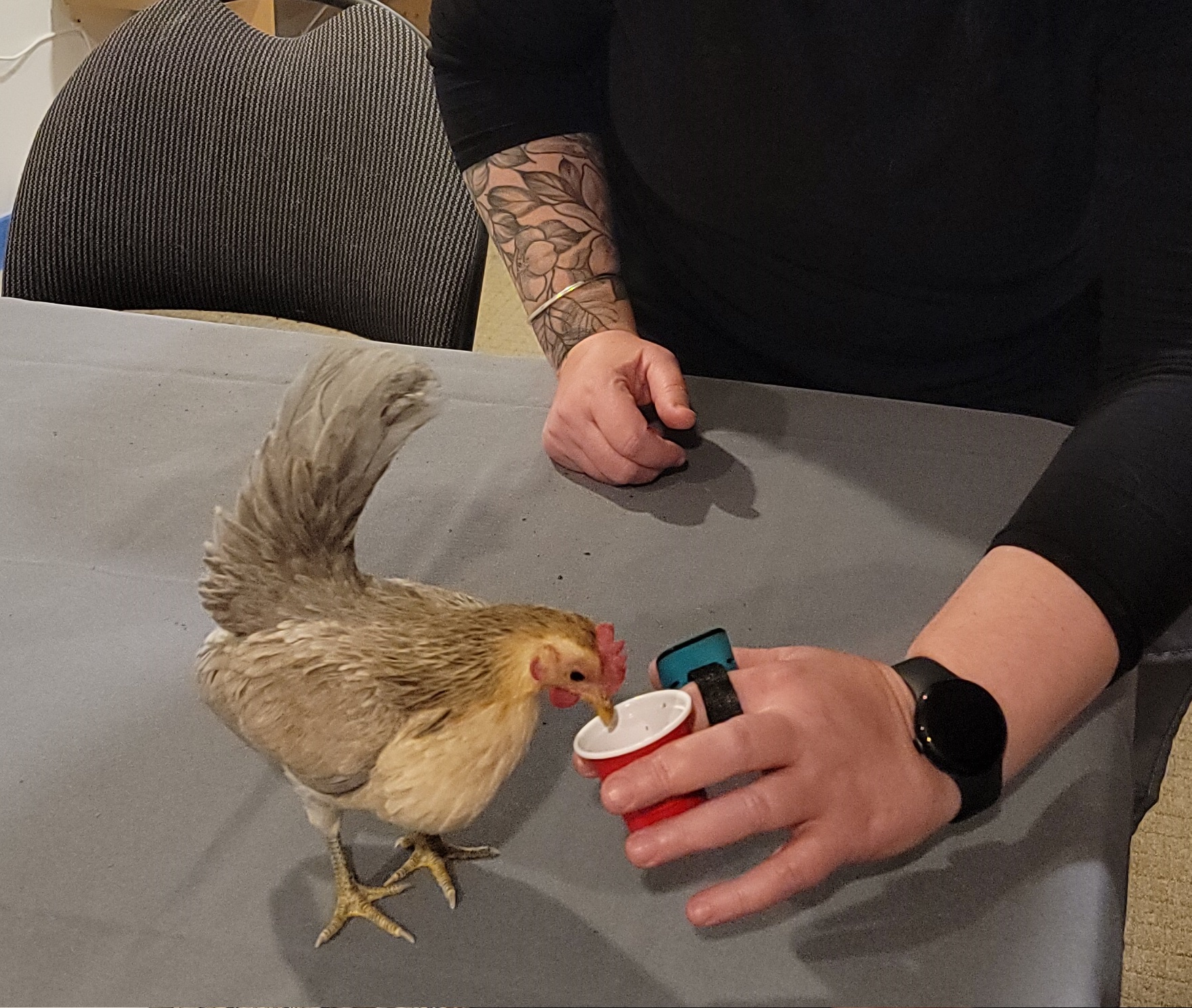
Dog trainers are constantly seeking ways to refine their skills, improve their timing, and become more effective in their training methods. One of the most unconventional yet highly effective ways to achieve this is through clicker training chickens, also known as Chicken Camp. While it may seem surprising at first, training chickens sharpens essential skills such as timing, precision, hand-eye coordination, problem-solving, and effective decision-making, all of which translate directly to better dog training.
Why Train Chickens?
Chickens have a fast reaction time and require trainers to be incredibly precise. Unlike dogs, they don’t respond to social cues in the same way, forcing trainers to rely solely on learning theories. This makes chicken training an ideal way to hone technical skills that might otherwise be overlooked when working with dogs.
1. Timing: The Foundation of Effective Training
Timing is everything in animal training. A reinforcement that comes too late, or too early, can cause confusion and slow learning. Chickens peck rapidly, so a trainer must click at the exact moment the desired behaviour occurs.
A study by Ferguson & Rosales-Ruiz (2001) demonstrated that precise timing improves an animal's ability to associate cues with rewards, making learning more efficient. This skill is transferable to dogs, where quick reinforcement can mean the difference between a well-timed behaviour and a missed training opportunity.
2. Precision: Fine-Tuning Training Skills
Training chickens forces dog trainers to become more precise in their actions. Every click and every food placement must be intentional. Because chickens don’t respond to lures like dogs, trainers must shape behaviour through micro-adjustments in timing and reinforcement placement.
Research on marker-based training (Feng, Howell & Bennett, 2018) highlights how precision in reinforcement enhances an animal's ability to learn complex behaviours. By practicing with chickens, dog trainers improve their ability to deliver reinforcements with pinpoint accuracy.
3. Hand-Eye Coordination: A Trainer’s Muscle Memory
Clicker training chickens is a physical and mental exercise that improves hand-eye coordination. Since chickens move quickly, a trainer must click and reinforce without hesitation. This strengthens motor skills that are essential for handling dogs, especially in agility training, service dog work, or complex behavioural shaping.
4. Problem-Solving: Adapting to Different Learning Styles
Each chicken learns differently, just as every dog does. Trainers must adapt their strategies, recognize subtle changes in behaviour, and modify training plans in real-time. Working with different chickens helps trainers build flexible problem-solving skills, which are crucial for addressing the unique needs of each dog.
Skinner’s operant conditioning principles (1938) emphasize the importance of adaptability in training. Learning how to adjust reinforcement schedules and criteria during chicken training mirrors the adjustments dog trainers must make when working with different breeds, temperaments, and learning speeds.
5. Effective Decision-Making Under Pressure
Because chickens react quickly, trainers must make split-second decisions. This sharpens a trainer’s ability to analyze behaviour in real time and respond appropriately. When working with dogs, this translates into making better training decisions, especially in fast-paced environments like obedience competitions or behaviour modification sessions.
Sharpening Dog Training Skills Through Chickens
Clicker training chickens is more than an entertaining challenge; it’s an advanced training exercise that refines the fundamental skills every dog trainer needs. From timing and precision to problem-solving and decision-making, working with chickens pushes trainers to become more competent and effective. The lessons learned during Chicken Camp workshop directly translate to better communication and faster learning outcomes when working with dogs.
For dog trainers looking to elevate their skills, stepping into the world of chicken training is an unexpected yet powerful way to achieve professional growth.
References:
- Feng, L. C., Howell, T. J., & Bennett, P. C. (2018). Practices and perceptions of clicker use in dog training: A survey-based investigation of dog owners and industry professionals. Journal of Veterinary Behavior, 23, 1-9. https://doi.org/10.1016/j.jveb.2017.10.00
- Ferguson, D. L., & Rosales-Ruiz, J. (2001). Loading the problem loader: The effects of target training and shaping on trailer-loading behavior of horses. Journal of Applied Behavior Analysis, 34(4), 409-424. https://doi.org/10.1901/jaba.2001.34-409
- Skinner, B. F. (1938). The Behavior of Organisms: An Experimental Analysis. Appleton-Century.