
By Gaby Dufresne-Cyr, CBT-FLE
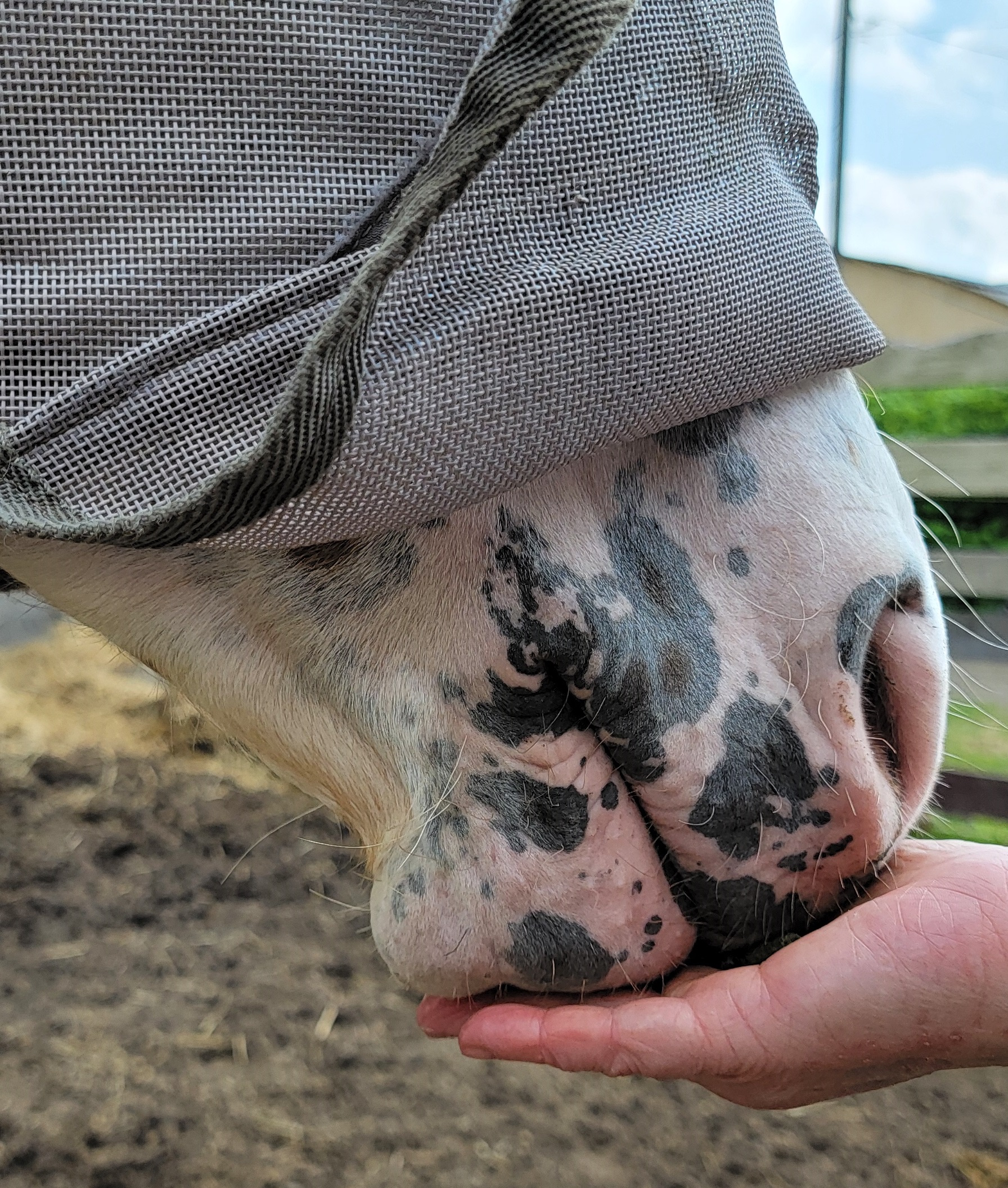
In Horse Training Part 1, we discusses cognitive learning in horses. In Horse Training Part 2, we will discuss how horses learn from one another, and what role can humans play in this process? These questions are central to understanding social learning in horses and have important implications for horse training.
Article Summary
|
Horses live in social environments, and the presence and actions of other individuals influence their behaviour. However, observing a horse follow another horse does not automatically establish that it has learned a new skill through imitation. Understanding social learning requires us to examine what information the animal acquired and how it acquired it.
Social Cognitive Animal Training (SCAT) brings together behavioural, social, cognitive, and environmental perspectives to examine learning as a relationship-based process within real-world situations.
What Is Horse Social Learning?
Social learning broadly refers to learning by observing or interacting with other individuals. In animal behaviour research, we distinguish between several related processes.
Social facilitation occurs when the presence or activity of another individual influences the likelihood that it will exhibit a behaviour. Imitation refers to reproducing aspects of another individual's behaviour, while other forms of social referencing may involve acquiring information about an outcome or goal.
These distinctions are important because the same visible behaviour can arise through different learning processes. For example, a horse might approach an object after seeing another horse investigate it. The first horse may have become more attentive to the object or location.
Horses Learn from Social Interaction
Social interaction can influence how horses respond to unfamiliar situations, other animals, and humans. The precise mechanism may differ between situations, and we should evaluate the outcome in context.
Three Benefits of Social Learning in Horses
|
The same principle applies to interactions between horses and humans. Humans provide cues, movements, demonstrations, and changes in the environment that horses may respond to. Research into human-horse communication and social learning continues to examine the information horses can acquire from human demonstrators.
For trainers, the practical lesson is to remain curious about how information is being communicated and to assess learning through objective observable changes in behaviour.
Cognitive Learning and Social Learning Horse Training
Cognitive learning and social learning address related but distinct questions. Cognitive learning concerns processes involved in acquiring and using information, while social learning focuses on how social connections influences learning.
In practice, these dimensions may interact. A horse may notice another individual's behaviour, attend to a particular object, remember the experience and later investigate the object independently. Establishing the exact process would require appropriate observation or experimental testing, but the example illustrates why it is useful to consider multiple dimensions of learning.
Horse training can also provide opportunities for social referencing and problem-solving. Trainers can demonstrate a task, arrange the environment to make relevant information accessible, and then observe how the horse responds.
Four Horse Behaviour Feedback Questions
|
These behaviour outcome observations can help the trainer decide whether to repeat the exercise, adjust the environment, simplify the task, or introduce a new challenge. A useful training programme considers both what the horse is learning and the conditions under which that learning occurs.
Attachment Between Human and Horse is Part of Learning
Horse training is a social interaction. The human's timing, body language, consistency, and response all contribute to the learning situation.
Attachment theory offers a way to consider how relationships and security may affect exploration and engagement. In Social Cognitive Animal Training, the secure-base concept is one component of a wider framework for understanding learning.
A trainer can support learning by providing predictable interactions, responding to the horse's signals, and offering tasks that are appropriate to the animal's experience. When a horse shows uncertainty or difficulty, the trainer can reassess the social, cognitive, and environmental conditions.
This requires observation rather than assumption. A horse's behaviour may reflect several interacting influences, including previous experience, trust, agency, physical comfort, emotional state, and other individuals.
The aim is to understand the conditions associated with the horse's response and to adjust training accordingly.
Social Cognitive Animal Training Integrates Learning Theories
I developed Social Cognitive Animal Training (SCAT) to bring together perspectives that are often examined separately.
Within SCAT, these perspectives contribute to an integrated view of animal learning. The framework considers the animal's cognitive abilities, social relationships, learning history, and environment.
The purpose is to help trainers make informed decisions about how to introduce tasks, how animals respond to them, and how we can support learning across situations and environments.
The Social Cognitive Animal Training Framework
|
For horses, this can mean combining clear behavioural teaching with opportunities for exploration, appropriate social experiences, predictable communication, and gradual exposure to different environments. The framework also emphasizes the importance of trust, choice, and observation.
SCAT is an applied framework established by combining learning theories. We should still evaluate specific claims about equine cognition or social learning against the relevant scientific evidence. Integrating theories provides a way to organize practical questions; it does not eliminate the need to test individual claims.
From Conditioning Behaviour to Learning How to Learn
Horse training involves teaching useful behaviours, developing reliable responses, and helping horses cope with the situations they encounter. An integrated approach adds another objective: supporting the animal's ability to use experience when circumstances change.
This requires attention to the learning environment. A task may need to be introduced in a familiar setting before the horse can practice the behaviour safely elsewhere. A demonstration may help in one situation, while independent exploration may be more informative in another.
For me, the value of SCAT lies in bringing conditioning, cognition, social relationships, and environmental conditions into a shared framework that can guide practical work with animals.
A Broader Future for Horse Training
Research into equine cognition continues to develop. Studies of memory, spatial cognition, discrimination, social learning, and human-horse attachment are expanding our understanding of how horses acquire, process, and use information.
Trainers can contribute to science by documenting what they observe, distinguishing evidence from interpretation, and remaining open to revising their explanations.
Social Cognitive Animal Training offers one framework for everyday horse training goals. When we consider a unified model, we can work toward training that supports learning, adaptability, agency, and collaboration between horses and humans.
The central question is no longer limited to which behaviour a horse can perform. It includes the ultimate question: how does the horse learn how to learn.
Article Takeaway
|
Continue with Horse Training Part 1: Cognitive Learning in Horses.
About Gaby Dufresne-Cyr
Gaby Dufresne-Cyr is the founder of Social Cognitive Animal Training (SCAT), an integrated framework for understanding animal learning through behaviour, cognition, social relationships, and environmental influences. A professional animal trainer, educator and author, she founded Dogue Shop in 1999 and Dogue Academy in 2009. Her work draws on learning theory, animal behaviour and four decades of practical experience with dogs, horses, wolves, and animal-assisted interventions. Through her books, educational programmes and writing, Gaby explores how understanding the way animals learn can support trust, adaptability and stronger human-animal relationships.
References
- Brubaker, L., & Udell, M.A.R. (2016). Cognition and learning in horses (Equus caballus): What we know and why we should ask more. Behavioural Processes, 126. 121-131. ISSN 0376-6357. https://doi.org/10.1016/j.beproc.2016.03.017
- Ricci-Bonot, C., Brosche, K., Baragli, P., & Nicol, C. (2025). A systematic review on the effect of individual characteristics and management practices on equine cognition. Animal Cognition, 28 (96). https://doi.org/10.1007/s10071-025-02016-2
- Rørvang, M. V., Christensen, J. W., Ladewig, J., & McLean, A. (2018). Social Learning in Horses-Fact or Fiction?. Frontiers in veterinary science, 5, 212. https://doi.org/10.3389/fvets.2018.00212